

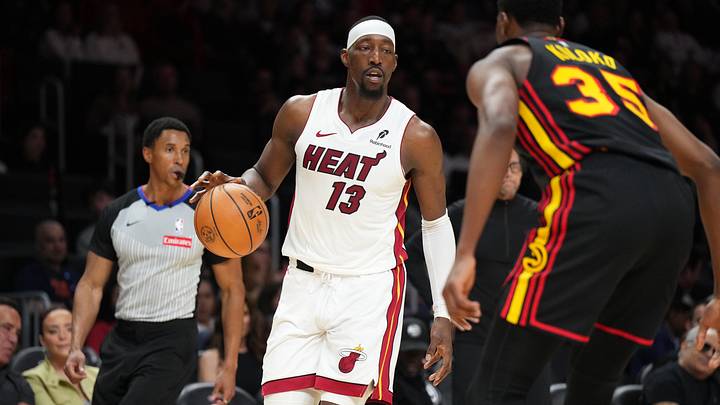
With the Miami Heat all but guaranteed to make some big changes to their roster this offseason in order to vault themselves into contention, it's worth taking a look at what's worked in these playoffs for other teams to see what the Heat could replicate, or at least imitate.
Obviously, every team is unique in its roster construction and scheme, so some things that work exceptionally well for one team may completely fail for another. But this is a copycat league, and we often see teams try to emulate the success of others once a strategy is proven to work in the biggest moments.
There are only four teams remaining in the 2026 playoffs, and each had to win multiple playoff series to get to where they are. Let's take a look at each of them and identify one thing the Heat can learn from their success.
Cleveland Cavaliers: You can start two bigs together
This is more relevant to the current construction of the Heat, but it ties directly into one of the team's biggest talking points over the last two seasons. The Bam Adebayo/Kel'el Ware experience has frustrated many fans thanks to how inconsistently they've shared the court, but there are real reasons Erik Spoelstra hasn't pushed that button as much as many have hoped.
Aside from the fact that Ware is still actively developing and the team must endure the ups and downs that come with it, there are offensive concerns that come with playing two big men who traditionally haven't been knockdown threats from deep at a volume large enough to make defenses care.
Even still, the benefits of playing a real rim protector next to Adebayo, one of the most versatile defenders in modern history, are palpable; according to Cleaning the Glass, the Heat posted a +6.7 net rating during the regular season with both players on the floor this year, buoyed by a stellar 110.1 defensive rating.
But the playoffs are a different sport, and some strategies that find real success during the regular season can be snuffed out if the foundation isn't strong enough. This takes us to the Cavaliers, who have started Evan Mobley and Jarrett Allen together for the last five seasons. The fit between those two has been brought into question many times over the years as the team has failed to match its regular-season success in the playoffs, and this year shaped up to be potentially the final test of their viability.
For the first time ever, this core is in the Eastern Conference Finals, and the play of their bigs has been a major contributing factor. During the regular season, Cleveland posted a +7.6 net rating with both bigs on the court, with a similarly strong 111.0 defensive rating to the Heat with Bam and Ware. Allen can assume on-ball defensive responsibilities in the pick-and-roll, freeing up Mobley as one of the league's most terrifying roamers. That sounds a lot like what Ware can do for Bam. Rostering both players also means you can stagger their minutes throughout a game, mitigating some of the drawbacks of having both on the floor while keeping an impactful big man out there for 48 minutes.
Their net rating in the playoffs has fallen to +2.4, which is solid if unremarkable. But that drop has everything to do with the team's offense getting worse — their defensive rating still sits at 111.2. When you consider that Cleveland's two playoff opponents were both top-seven defenses, it's pretty understandable why this happened. You could even argue that this can give Heat fans hope. Allen is a non-shooter, and Bam and Ware are both arguably better shooters than Mobley. There's a world where offensive lineups featuring both can be more potent than Cleveland's double-big look.
Mobley and Allen have proven that playing two high-level big men together can work over a long playoff run. If Ware is still on the team next season (and that's a real if, considering the changes that may be on the horizon), that should be a major source of optimism for Heat fans moving forward.
New York Knicks: A playmaking big man can still unlock an offense
This is an idea Heat fans should be very familiar with.
Adebayo's breakout as a star all the way back in 2019-20 came as a game-changing defender on one end, and a playmaking fulcrum on the other. His chemistry in dribble handoffs with Duncan Robinson was immaculate, and his vision, combined with his screening prowess, made life easier for everyone else on the floor.
We all know that the Heat team made the NBA Finals, but it may come as a surprise to some that they also had the highest-ranking offense of any team in the Adebayo era (7th leaguewide). Not only that, but Miami has never posted another top-10 offensive rating since. After ranking 25th in 2022-23 and 21st in each of the next two seasons, Spoelstra decided to overhaul the offense to try to juice things up.
The result was what we saw this season, where screens were all but eliminated from the playbook in favor of drive-and-kicks, drives forcing help, and a major injection of pace. It worked, but not completely; they finished 12th leaguewide in offensive rating, a major upgrade to be sure, but still not approaching elite. There were also some major cold stretches that the full-season numbers don't show.
A major talent upgrade could improve those numbers if the offense largely stays the same, but the Heat have an in-house option, too. This year's Knicks are a fantastic example of what leaning into your big as a passer can do for an entire offense. Through their first three playoff games, an exceptionally talented lineup by any objective means punched well below its weight on offense, leaning too heavily into isolation basketball to manufacture points and try to get defenses into rotation. After dropping two of those, they completely inverted the offense to run through Karl-Anthony Towns, and they've been historically dominant ever since.
Towns' ability to shoot pulls his defender away from the basket, and when you pair that with off-ball movement and screening from the other four players, you create defensive havoc and a whole ton of good shots. Over the last few seasons, but especially this one, Adebayo has been asked to be less and less of a playmaker. One of the benefits of that shift is that he's become a volume three-point shooter for the first time in his career. If Miami wants to lean back into his playmaking, having that skill in his arsenal would make it all the more unguardable.
Such a shift would require a pretty drastic offensive change from the Heat for the second year in a row. It would likely resemble something closer to the early Adebayo days, with complex off-ball actions and multiple players setting screens and cutting around the floor. If the roster looks meaningfully different, maybe that would be easier to pull off. Regardless, the Knicks have shown that you don't need to have Nikola Jokic to run a highly effective offense through your center. Miami's captain gives them the option to at least try it for themselves.
Oklahoma City Thunder: To play fast, you need to defend
I mentioned above that one of the key tenets of Miami's offensive overhaul this season was by amping the pace. I may have undersold it.
The last time the Heat ranked in the top half of the league in transition frequency was 2020-21; before that, you have to go back to the four years with LeBron James; before that, it was their first championship team in 2005-06. In nearly every other year, they were among the bottom ten.
Miami finished this season second.
A franchise usually dedicated to a slower, deliberate offense threw it all out the door to try to make their offense more viable. The results were mixed, as they ranked 18th in points per play in transition, meaning they weren't able to maximize their many fastbreak possessions. But it still worked enough to improve their offense, and it wouldn't be surprising to see that part of their scheme continue next season.
The much bigger issue than middling efficiency was that as they shifted away from one organizational tenet, they lost sight of the other, much more foundational one — their defense. The Heat ranked 13th overall in defensive rating this season, but they fell off a cliff during their last 15 games, culminating in a Play-In Tournament loss to the Hornets. In that game, they scored a blistering 126 points over exactly 100 possessions, which would have ranked first in the league over a full season by a mile. The issue was that they gave up 127.
You might be asking: What does this have to do with the Thunder? The answer is, more than you might think. Over the last 3 seasons, OKC has emerged as a potential budding dynasty behind a truly generational defense. They smother opposing stars and force a laughable number of turnovers, and that allows them to run the break quite often, supporting a half-court offense that can at times get stuck in the mud.
Oklahoma City defies the conventional wisdom that the game slows down in the playoffs, because they're able to completely dictate the terms of engagement. Playing suffocating defense allows them to be freer on offense, and a good chunk of their transition opportunities are one-on-zero affairs after one of their guards pokes the ball free for a steal.
Beyond just getting more stops, the Heat should aim to force more live-ball turnovers and create better transition possessions for themselves. I'm not asking Miami to replicate the best defense of this decade. But this is a franchise that has always put effort and excellence on that end at a premium, so it's reasonable to expect a regression to the mean next season. So long as pushing the pace remains a priority, they're going to need it if they want to stay afloat.
San Antonio Spurs: Having multiple downhill ball handlers is a cheat code
Where the other three takeaways have to do with what we saw from the Heat this season, this one looks forward with the presumption that major changes are ahead moving forward. There are many avenues Miami can take to improve the team, but the Spurs are demonstrating in real time one real pathway to success that the Heat just couldn't access this season.
They've ascended to the Western Conference Finals in the first postseason with this core in no small part thanks to Victor Wembanyama, but their roster also presents a major, major issue for opposing defenses: the three-headed monster that is their guard room. Between De'Aaron Fox, Stephon Castle, and Dylan Harper, San Antonio can overwhelm opponents with not one, not two, but three perimeter players that can get to their spots at will. When those spots are almost entirely in the paint, there's not a lot you can do.
Fox's speed makes him a constant threat to get to the basket, and his veteran polish lets him get to his spots with ease if you try to take that away. Castle is just an overwhelming physical presence, with the strength, power, and athleticism to bully his way to the basket. Harper's a rookie who plays like a multi-year veteran, with the guile and poise to work his way through multiple defenders and finish with preternatural touch. It helps that all three are either current or future All-Stars, but the point remains that defenses have to account for all three.
If you successfully scheme one of them out of a game, there are still two more who can hurt you. That they do it in different ways to get to the same results hurts even more. For 48 minutes, you're stuck dealing with at least two of them at once at all times. Their constant rim pressure with the ball in their hands bends defenses until they snap. The value of secondary ball-handling has always been known, but the Spurs are pushing it to an extreme.
Contrast that with the Heat this season, who really only had Davion Mitchell to fit this mold. Mitchell had a strong season, showcasing his ability to burrow to the basket and make plays out of it, but he isn't the kind of player to single-handedly uplift a backcourt. Now, if the Heat add a high-level downhill perimeter threat and move Mitchell to the bench, that could enhance this team in a very real way.
Getting 48 minutes of rim pressure out of the backcourt would make life vastly easier in the halfcourt for everybody else, and Mitchell has shot well enough in Miami to make me believe that he can play off the ball next to that player, too. If the Heat can add two of those guys, then they'll become a problem not many defenses can solve.
This is obviously a tall ask, but with names like Ja Morant on the trade market, one has to wonder just how far away the Heat are from making something like it happen. Whatever big swing Miami makes will determine how its team-building process will go, but the Spurs have provided one potential blueprint.
 Add us as a preferred source on Google