

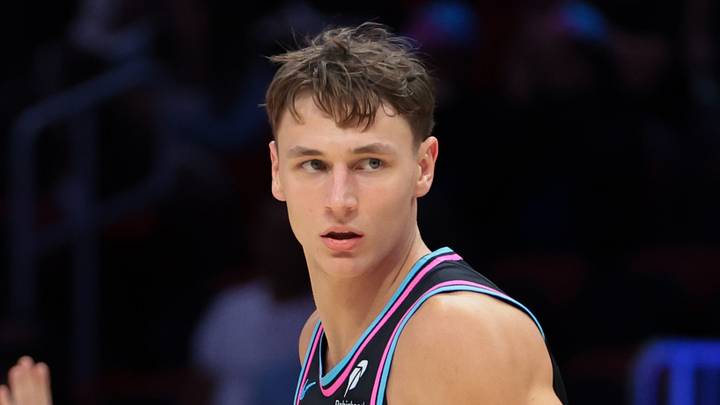
The Miami Heat have a decision to make about the starting shooting guard role. It’s a discussion that fans are likely sick of at this point, as the debate between Tim Hardaway Jr., Pelle Larsson, and Klay Thompson has been raging for some time and typically centers around a simple question: What’s more valuable between Larsson’s defense and Hardaway or Thompson’s shooting?
Though benching Larsson—a borderline elite defender with a budding all-around game—would be a tough pill to swallow, making him the sixth man may actually be the best way to amplify his impact and tap into his potential.
Larsson is a 6’5” and 212-pound wing with a near 6’8” wingspan, explosive athleticism, and the film to turn skeptics into believers. He plays hard-nosed defense against players at multiple positions, skies above the rim for awe-inspiring finishes, and has the raw playmaking and shot creation skills to suggest there’s untapped potential to explore.
There’s certainly a vacuum on the offensive end of the floor that Larsson could grow to fill, but at least at the start of the season, it’s likely that Andrew Wiggins will be the priority along the wings.
Wiggins is a former All-Star who played a critical offensive role on a championship team. As such, the 3-and-D specialist is likely to be trusted in a prominent position due to his ability to not only create his own offense, but provide spacing for Giannis Antetokounmpo and Bam Adebayo.
That makes a move to the second unit potentially ideal for Larsson, who can continue working on his jump shot while refining his shot creation and playmaking skills in a more prominent offensive role as the Heat’s sixth man.
Pelle Larsson can test the limits of his offensive game as Heat’s sixth man
Larsson finished the 2025-26 season with averages of 11.4 points, 3.5 rebounds, 3.4 assists, 1.0 offensive rebound, 0.7 steals, and 0.9 three-point field goals made in 26.4 minutes per game. He took a considerable step forward in the all-around efficiency department, jumping from a 2024-25 slash line of .438/.337/.672 to 2025-26 marks of .496/.323/.797.
That includes a massive increase from .528 to .586 on two-point field goals, a jump in eFG% from .517 to .551, and an uptick from .546 to .605 in true shooting percentage.
Translate Larsson’s averages to a per-36 basis and it becomes even more clear how much he has to offer. The 25-year-old posted 15.6 points, 4.8 rebounds, 4.6 assists, 1.0 steal, 1.3 offensive boards, and 1.2 three-point field goals made per 36 in an impressive 2025-26 campaign.
After increasing his production by 4.0 points and 1.6 assists per 36 minutes between his rookie and sophomore seasons, it’s fair to ponder far his potential reaches.
Pelle Larsson would get more touches, a bigger role as sixth man
The reality of playing with Antetokounmpo, however, is that isolation touches and shot creation opportunities will come in relief of his contributions. That will be a massive shift from a 2025-26 campaign during which Adebayo led the Heat with 15.7 field goal attempts per game and Norman Powell led the team in usage rate at 26.2.
Antetokounmpo, by comparison, has averaged 18.7 field goal attempts per game over the past nine seasons and hasn’t posted a usage rate below 32.0 since 2018-19—when he checked in at 31.4.
Moving Larsson to the second unit would thus create more opportunities for him to create for himself and others. Whoever doesn’t start between Hardaway and Thompson would give the bench a sharpshooter, while Nikola Jovic, Bobby Portis Jr., and Nick Richards will be trusted to lead the frontcourt.
With the second unit lacking proven shot creation and facilitating, that would thus leave Larsson to explore his potential in a role that tests his limits. It may actually be his optimal outcome.
 Add us as a preferred source on Google