

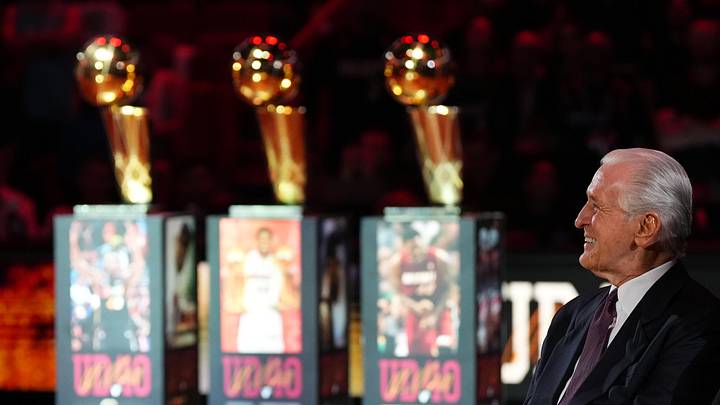
The Miami Heat have a formula.
From the moment Pat Riley took over in 1995, the Heat have stuck to one plan: acquire a superstar (or two), and make whatever moves around them they need to in order to contend.
It started with Alonzo Mourning that summer, then Tim Hardaway at the next trade deadline. During Riley's first crack at the throne, both would make an All-NBA First Team as the Heat routinely compiled one of the league's best regular-season records.
But the farthest those teams got was the 1997 Eastern Conference Finals, where they fell to the Bulls in five games. In each of the next two seasons, they would be upset in the first round (as a two- and one-seed, respectively). By the start of the 2000s, the team was unrecognizable.
The Heat's Dwyane Wade era
Their fortunes changed in 2003, when they drafted the greatest player in franchise history. After just one season of Dwyane Wade around an intriguing young core, Riley understood the Heat were one swing away from launching right back into the inner circle.
With Shaquille O'Neal next to Wade, Miami returned to the Eastern Conference Finals right away. But this time, Riley understood that urgency was still necessary to ascend to the next level. That summer, the Heat shook up the roster in a major way, adding two new starters in Jason Williams and Antoine Walker and bolstering their depth with the likes of James Posey and Gary Payton.
Further still, when the team underperformed early in the season, Riley decided to resume his post as head coach, sending Stan Van Gundy home and helming the ship in the middle of a storm. The team that had just made the Conference Finals looked almost unrecognizable — and it worked. In 2006, the Heat became champions their way. It was a validation of the blueprint built by Mourning and Hardaway, and it became a precedent for how the Heat would keep winning.
Once that core faded as Wade ascended to the peak of his powers, the Heat knew exactly how to vault right back to the top. Everybody knows what happened next: the Big Three era and back-to-back championships. What gets discussed much less is just how violently the Heat turned over their roster to fit around Wade, LeBron James, and Chris Bosh.
The first edition of the Heatles in 2010-11 featured ten new players from the year before. The pivot into superstar mode couldn't have been quicker, and it didn't stop there. The Heat became the juggernaut they were supposed to by surrounding their stars with the exact players that they thrive around, from Mike Miller to Shane Battier to Ray Allen. Once again, Miami's formula delivered.
That era ended with LeBron's second decision, swinging the pendulum back to mediocrity. Bosh's blood clot diagnosis ended his career, and Wade left in free agency not long after. The team was asset-poor and aimless, too good to tank yet lacking the top-end talent to do anything of consequence.
The post-Wade era for the Heat
But they did draft Bam Adebayo with the 13th pick in 2017. Even though he was a backup for his first two seasons, he stood out among a litany of homegrown talent as a star candidate. Realistically, the Heat only needed one young player to stand out alongside Goran Dragic because they were ready to leap right back into the fray.
The Jimmy Butler era proved the Heat's formula beyond a shadow of a doubt: two NBA Finals trips, including one as the eighth seed. But paradoxically, its success ultimately created a hubris that doomed it. Miami's reluctance to make meaningful moves while holding out for star trades that never came led to nothing but talent drain in free agency, angering Butler to the point of a trade demand.
Everyone understood that, for as good as they were, the Heat had overachieved. Everyone, that is, except for the Heat. The meaningful moves that defined the championship teams were nowhere to be found.
Miami returned to the middle of the pack once again, but this time had nothing to show for it. Some will claim it as evidence that Riley's lost his fastball, that the Heat's way simply isn't viable anymore. Maybe it's the exact motivation the Heat need.
There's a specific kind of roster build around Antetokounmpo that has proven championship results. Your centers need to space the floor, and pairing him with an elite defensive anchor in the starting lineup creates an elite foundation. Bam Adebayo checks both boxes with his newfound three-pointer, and who better to slot in as backup center than Bobby Portis, the backup center on Milwaukee's title team?
But there's much more to be done. Miami's guard room has become frighteningly thin, and they'll need players who can dribble, guard, and shoot. Right now, it's just Davion Mitchell — that won't cut it. Andrew Wiggins is a two-way option on the wing, but Norman Powell's free agency looms large. Can they retain their best perimeter shot creator while adding in other places? How do they compensate if they lose him?
There are major questions to be answered in the immediate wake of this move. The next few months will be exceptionally illuminating. Thanks to Miami's tried and true formula, its championship window has cracked open once again. If there's anything the Heat's history has taught us, they'll do whatever it takes to leap through.
 Add us as a preferred source on Google