

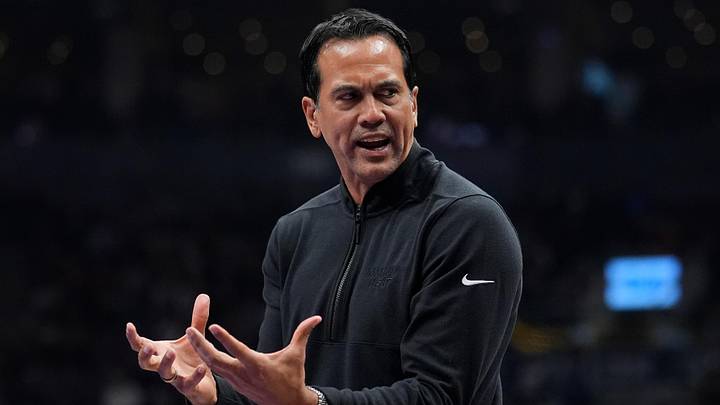
Heat Culture has become synonymous with the practice of bringing the best out of supporting players and fringe stars. With Erik Spoelstra continuing what Pat Riley previously established, the Miami Heat play hard, move the ball well, stay in shape, and trust one another with absolute certainty.
If the Heat are serious about returning to the ranks of the contenders, however, then they'll need to prove it at the 2026 NBA Draft by taking a chance on star potential.
Finding high-level role players who fit the system explains how the Heat managed to reach the NBA Finals twice and the Conference Finals three times between 2020 and 2023. They complemented Jimmy Butler, an All-NBA cultural fit, with hard-working players who knew their respective roles.
That enabled Butler and Bam Adebayo to anchor improbably consistent runs through the playoffs, with the former turning into a supercharged version of himself in clutch moments.
Fast forward to 2026, however, and Butler's rather sudden departure in 2025 has left a void that the Heat still haven't filled. Many hoped that Tyler Herro would be next in line to become the franchise's go-to offensive player, but external faith has been rattled on that front and Miami is now at something of a crossroads.
Though it's tempting to simply go with another player whose skill set is an ideal fit at the 2026 NBA Draft, the Heat must capitalize on this opportunity to swing for the fences at No. 13 overall.
Are the Heat willing to gamble on upside? Or is it all about fit?
Miami has a perfectly solid roster that produced a 43-39 record despite playing 49 games without Tyler Herro, 24 without Norman Powell, and 35 down Nikola Jovic. It ranked in the top half of the NBA in offensive rating, defensive rating, and net rating, and finished ninth in opponent field goal percentage and 15th in field goal percentage.
By most means and measures, the Heat have the depth, talent, coaching, and balance to remain competitive and at least feature into the Play-In Tournament equation for several more seasons.
What the 2025-26 season revealed, however, was how desperately they needed stability in the lead scoring role. Three different players averaged at least 20.1 points per game, but Powell's 21.7 still fell below the mark in terms of high-level first options.
Balance is an unavoidably valuable strength, but the postseason routinely rewards the teams whose best players can put the offense on their back in a tough spot. Though Butler proved that regular season numbers don't determine postseason output, Miami doesn't yet have an ideal No. 1 who can rise in a similar fashion.
Perhaps the Heat won't find a player of that caliber at No. 13 overall in the 2026 NBA Draft, but there will be upside to explore. As such, Miami can at least get closer to achieving that goal if it drafts the right upside player and successfully develops them.
Throw in the fact that Powell will soon be a 33-year-old free agent and Herro's market is generally unknown, and the Heat must prove how serious they are about escaping limbo at the draft.
 Add us as a preferred source on Google